From Bangalore to the Bot

I’ve Seen This Movie. What the AI Wave Can Learn from the Off-Shoring Boom
Two decades ago corporate America discovered that fiber-optic cable could teleport routine office work to a night-shift halfway around the world. Today, GPTs are teleporting the work itself right out of the job description. The numbers say both shocks “created” plenty of jobs—but headline counts missed the real story of hollowed-out security and sagging morale. Here’s what the new AI transition can learn from the BPO/KPO era before it’s too late.
Act I: The Great Un-coupling
In the 1990s and early 2000s, business-process outsourcing (BPO) and its white-collar cousin KPO promised cost savings and a seamless global workflow. The promises came true—just not for American middle-skill workers.
Manufacturing’s vanishing floor: Between 2000 and 2010 the U.S. shed almost six million factory jobs; analysts estimate about 40 percent of that drop stemmed directly from off-shoring decisions. Investment MonitorNBER
A U-shaped labor market: As MIT economists David Autor and David Dorn showed, high-skill professional roles and low-skill services both grew while routine clerical and production jobs collapsed, producing the now-familiar “job-polarization” curve. American Economic Association
Middle-class confidence cracked: Even after the economy added millions of service jobs, real median household income never again matched its 1999 peak, and by 2012 only 49 percent of Americans still called themselves “middle class.” Pew Research Center
Quality, not quantity, deteriorated: The University at Buffalo’s Job Quality Index shows a persistent tilt toward lower-wage, lower-hour positions, confirming that job mix mattered as much as the topline count. UB WordPress
Morale hit bottom: By 2013 Gallup found just 30 percent of U.S. workers “engaged” on the job—70 percent were checked-out or openly hostile. Vanity Fair
In short, the economy replaced middle-skill rungs with part-time footholds, leaving many workers technically employed but newly precarious.
Act II: Enter the Algorithms
Generative AI threatens another massive re-write—only this time the disruption stays onshore.
Scope: Brookings says more than 30 percent of U.S. workers could see half their tasks disrupted by AI, and 85 percent will feel at least some impact. Brookings
Speed: Unlike BPO contracts that took quarters to implement, LLM APIs roll out in days. McKinsey estimates AI could boost productivity 0.1–0.6 percentage points a year through 2040—if firms redeploy the freed-up labor wisely. McKinsey & Company
Scale: Goldman Sachs pegs the global exposure at the “equivalent of 300 million full-time jobs,” underscoring that no geography enjoys safe harbor. Goldman Sachs
Yet the AI boom also packs a hidden upside: the value added by the software is largely captured inside the U.S. firm rather than shipped overseas. Whether that dividend reaches workers depends on choices we have yet to make.
Act III: Measuring the Dignity Delta
The off-shoring era taught us that counting bodies tells us little about lived security. To avoid another blind spot, researchers are building a Dignity of Work Index (DWI) that tracks four pillars—livable wage, stability, agency, respect—alongside traditional payroll data.
Imagine pairing county-level DWI scores with Brookings’ AI-exposure map:
DWI_change = α + β (AI_Exposure × Post-Rollout) + controls
If β turns negative, we’d know AI is eroding more than it’s enriching—even before layoffs hit the news feeds. Early pilot data already hint at the pattern: small bumps in wages where firms share productivity gains, but sharper drops in perceived autonomy and engagement.
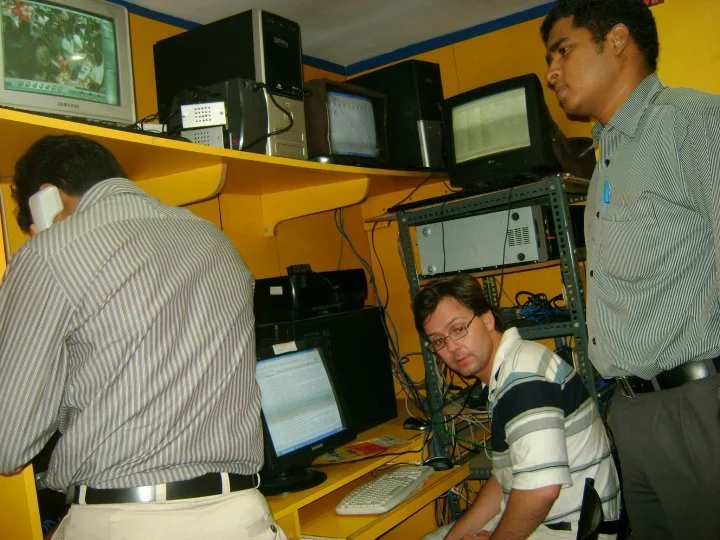
Sustainable outsource business models had to do with intention and relationship.
What Silicon Valley—and Congress—Must Steal From the 2000s Playbook
Missed Opportunity (2000-2010)AI-Era FixRetraining was an afterthought; Trade Adjustment Assistance reached a sliver of displaced workers.Fund portable skill accounts and wage-insurance that follow the worker, not the employer.Communities lost tax base as jobs moved overseas.Tie AI investment credits to place-based transition funds that offset payroll shrinkage locally.Gains flowed to capital, not labor.Bake profit-sharing or equity grants into large-scale automation projects.Data oversight lagged reality when customer information left U.S. shores.Mandate model-governance and bias audits as part of any enterprise AI deployment.
The Take-Away
Off-shoring proved you can add millions of jobs and still fray the social fabric when those jobs are low-wage, low-ladder, and low-dignity. AI could repeat—or reverse—that story. The technology’s productivity upside is real; so is the risk of a deeper bar-bell economy where only the top and bottom thrive.
The metric we watch will shape the future we get. Count the dignity, not just the jobs.